When process engineers transition from pilot programs to massive industrial manufacturing, the complexity of fluid dynamics increases exponentially. Top-entry mixers in large-scale operations are critical mechanical components that ensure consistent product quality across massive batch volumes. Understanding how these robust machines perform under immense physical stress is a natural progression for anyone who has already mastered the foundational concepts outlined in our Top-Entry Mixers 101: Engineering Guide. Managing thousands of gallons of viscous material requires highly specialized agitation strategies that go far beyond standard mixing protocols. At this industrial scale, every millimeter of shaft deflection and every fraction of a horsepower translates directly into high operational costs or savings.
The Role of Top-Entry Mixers in Industrial Manufacturing
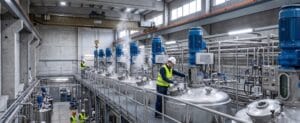
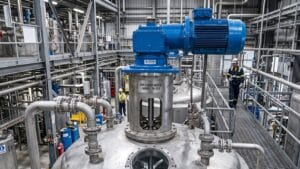
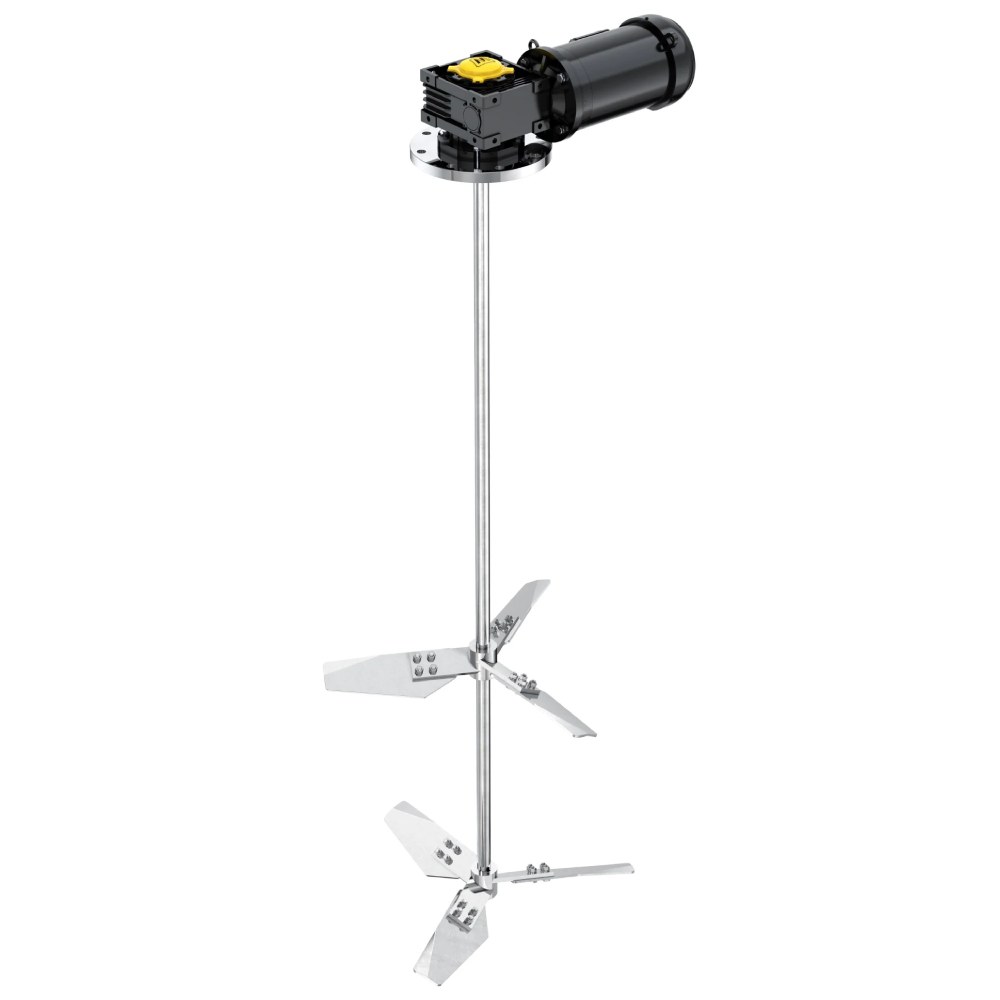
Industrial facilities rely on heavy-duty agitation systems to blend, suspend, and disperse materials across chemical, pharmaceutical, and wastewater treatment sectors. The sheer size of these production tanks demands mixing equipment capable of generating high flow rates without causing destructive vibrations. Top-entry mixers are uniquely positioned to handle these environments because they are mounted directly on the vessel’s structural supports, enabling them to support heavy-duty gearboxes and extraordinarily long shafts. This top-mounted configuration keeps the motor and mechanical seals safely above the fluid level, which greatly simplifies maintenance routines during continuous manufacturing cycles.
Scaling Up from Laboratory to Production
Moving a chemical reaction from a laboratory beaker to a massive industrial reactor is one of the most difficult challenges in process engineering. Engineers cannot simply scale up the physical dimensions of the mixing equipment and expect identical fluid behavior. Instead, they must carefully recalculate tip speeds, pumping rates, and shear forces to match the required process results at a much larger volume. This precise mathematical scaling ensures that the top-entry mixers deliver the exact same blend times and chemical reaction rates in a fifty-thousand-gallon tank as they did in a fifty-gallon pilot vessel.
Optimizing Fluid Dynamics for Massive Volumes
Achieving uniform consistency in large-scale operations requires a deep understanding of macroscopic fluid dynamics. As tank diameters increase, the potential for stagnant zones and unmixed product at the tank walls or bottom corners becomes a severe operational risk. Engineers combat this by utilizing specialized multi-stage impeller systems strategically positioned along the extended mixing shaft. These meticulously designed impellers work together to create comprehensive axial and radial flow patterns that push the fluid through the entire interior of the vessel, ensuring that no material remains unagitated.
Core Engineering Considerations for Heavy-Duty Agitation
Designing equipment for massive industrial tanks requires engineers to account for tremendous mechanical forces that do not exist in smaller applications. The fluid resistance encountered by impellers as they sweep through dense, highly viscous slurries imposes immense torque requirements on the entire drive assembly. Every component of the system must be engineered to withstand continuous, punishing operation without suffering premature fatigue or catastrophic failure. If you are exploring the broader category of Top-Entry Mixers, you will find that large-scale models require highly specialized gear reducers and reinforced bearing housings to handle these extreme loads.
Managing Mechanical Stress and Shaft Deflection
One of the greatest physical challenges in large-scale mixing is preventing the long impeller shaft from bending under the weight of the fluid resistance. When impellers encounter varying fluid densities or solid materials within a massive tank, the resulting side loads can push the shaft off its true center axis. To prevent this destructive bending, manufacturers utilize heavy-wall pipe shafts and precision-machined stabilizing rings that anchor the rotation and mitigate lateral movement. Maintaining a perfectly rigid shaft is absolutely essential to protecting the mechanical seals and preventing costly leaks of hazardous industrial chemicals.
Energy Efficiency and Motor Selection
Running heavy industrial agitation equipment consumes a massive amount of electricity, making energy efficiency a paramount concern for facility managers. Selecting the appropriate motor for top-entry mixers in large-scale operations involves balancing the necessary torque requirements against long-term power consumption costs. Engineers often pair high-efficiency motors with variable-frequency drives to give operators precise control over impeller rotational speed. This targeted approach allows the facility to dial back power consumption during different phases of the mixing cycle, ultimately saving millions of dollars over the equipment’s lifespan.
Advancing Process Reliability in Large-Scale Environments
The ultimate goal of deploying top-entry mixers in large-scale operations is to achieve uninterrupted, highly reliable production over years of continuous use. Unplanned downtime in a massive manufacturing facility can cost companies staggering amounts of money in lost product and stalled supply chains. By integrating advanced predictive-maintenance sensors that monitor vibration and bearing temperatures, modern process plants can detect microscopic mechanical deviations long before they cause system failure. Investing in robust, precisely engineered top-entry mixing technology ultimately provides the foundation for safe, efficient, and highly profitable industrial manufacturing on a massive scale.