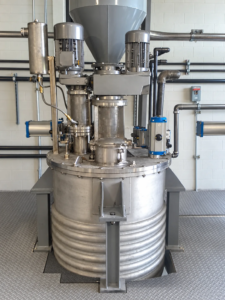
A pressurized tank mixer is usually easier and less expensive to maintain when changes are found before they become failures.
The goal of preventive maintenance is not to replace components on an arbitrary schedule. It is to understand what normally changes as the equipment wears and inspect those areas before they cause downtime.
For a pressurized mixer, several areas deserve particular attention.
What should be checked on the gearbox?
The gearbox should be maintained according to the manufacturer’s requirements for the specific unit and operating conditions.
Items commonly worth monitoring include:
- Oil level
- Oil condition
- Operating temperature
- Leaks
- Unusual noise
- Vibration
- Breather condition
- Mounting hardware
Lubricant condition can tell you quite a bit about what is happening internally.
Oil analysis may be useful on critical equipment or high duty applications. It can identify contamination, lubricant degradation, and changes in wear metals before a gearbox develops an obvious mechanical problem.
The appropriate sampling interval depends on the gearbox, service, operating hours, and criticality of the equipment.
Synthetic lubricants may also be appropriate in some high temperature or continuous service applications, but lubricant selection should follow the gearbox manufacturer’s requirements.
What should be monitored on a mechanical seal system?
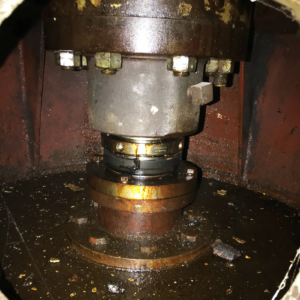
For mixers using double mechanical seals or external seal support systems, the support system should be part of the routine inspection.
Depending on the seal arrangement, useful checks may include:
- Barrier or buffer fluid level
- System pressure
- Fluid condition
- Leakage
- Reservoir temperature
- Cooling water flow
- Instrument condition
Changes are often more useful than any single reading.
A system that has historically held a stable pressure and fluid level but begins changing noticeably deserves investigation.
The correct barrier pressure depends on the actual seal design and process conditions. It should be maintained according to the seal manufacturer’s requirements rather than using one universal pressure differential for every mixer. Understanding mechanical seals in pressurized mixers covers how those arrangements work.
Why does vibration matter?
A long mixer shaft behaves differently from a short motor shaft.
Impeller buildup, blade damage, bearing wear, looseness, misalignment, shaft damage, or process changes can all influence vibration.
Trending vibration over time can help identify a change before it becomes obvious during normal operation.
On critical equipment, vibration analysis can provide more detailed information about possible imbalance, misalignment, bearing condition, or other mechanical problems.
Even without a formal vibration monitoring program, operators often notice changes in sound and vibration before a mixer fails.
Those observations should not be ignored.
What about shaft runout?
Shaft runout is particularly important when a mechanical seal is involved.
Excessive runout can create movement at the seal faces and shorten seal life.
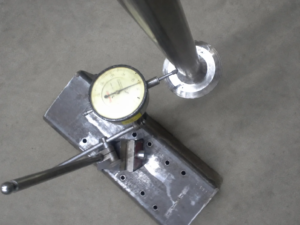
During a planned shutdown, runout can be checked with a dial indicator at appropriate locations.
The acceptable value depends on the shaft, seal, bearing arrangement, mixer design, and measurement location.
Rather than relying on one universal tolerance, measured runout should be compared with the equipment and seal manufacturer’s requirements.
If runout has changed significantly from previous measurements, the cause should be investigated.
Possible sources include:
- Bent shaft
- Worn bearings
- Damaged coupling
- Improper assembly
- Impeller damage
- Product buildup
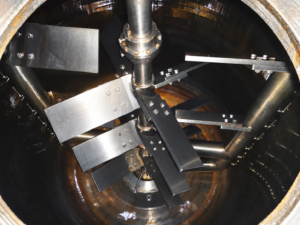
Inspect the impeller too
The impeller is often overlooked during maintenance because attention naturally goes to the gearbox and seal.
It should still be inspected whenever practical.
Look for:
- Bent blades
- Cracks
- Erosion
- Corrosion
- Product buildup
- Loose hardware
- Worn hubs
- Damaged welds
Even relatively small changes at the impeller can affect balance and hydraulic loading.
Keep a baseline
One of the most useful things a maintenance team can do is document what the mixer looks and sounds like when it is operating correctly.
Record normal:
- Motor amperage
- Gearbox temperature
- Vibration
- Speed
- Seal pressure
- Barrier fluid level
- Lubricant condition
That creates a baseline.
Future inspections can then answer a much more useful question than simply asking whether the mixer is still running:
Has anything changed?
In many cases, that change provides the earliest indication that maintenance is needed.
Working with Agitation Resources
We rebuild and retrofit mixers from any manufacturer, including units we did not build. Inspection happens at your site and the rebuild happens at our facility in upstate South Carolina.
We can supply aftermarket mixer parts regardless of manufacturer, including shafts, turbines, blades, hubs, steady bearings, and gearmotors, and we keep the drawings and part numbers on file for future work on the same unit. More on our pressurized tank mixers.