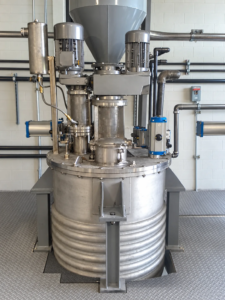
As viscosity increases, the way fluid moves inside a tank changes considerably.
A mixer that works well in a water like fluid may create very little useful circulation in a much more viscous product.
That makes high viscosity mixer design less about simply adding horsepower and more about creating the right flow pattern at the right speed and torque.
What changes as viscosity increases?
Low viscosity fluids can develop turbulent circulation that carries mixer energy throughout much of the vessel.
At higher viscosities, flow becomes increasingly laminar. Instead of turbulent eddies distributing momentum throughout the tank, layers of fluid move past one another much more gradually.
Many viscous materials are also non Newtonian.
Their apparent viscosity may change depending on shear rate, temperature, concentration, or other process conditions.
A shear thinning material, for example, may become much easier to move immediately around the impeller while remaining significantly more viscous near the tank wall.
This can produce areas of good local movement without good overall tank turnover.
Will a pitched blade turbine work in a high viscosity application?
Sometimes.
There is no single viscosity value where an open turbine suddenly stops working.
Performance depends on the impeller diameter, speed, tank geometry, fluid rheology, required process result, and several other factors.
As viscosity increases, however, relatively small open impellers can begin circulating only the material immediately around them.
At that point a larger diameter impeller or close clearance design may make more sense.
When are anchor or helical ribbon impellers used?
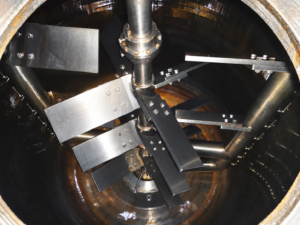
Anchor and helical ribbon impellers are commonly used when the mixer needs to move material through a large portion of the vessel diameter.
An anchor typically operates relatively close to the tank wall. This can be especially useful when wall heat transfer is important because the impeller continually renews the fluid near the vessel surface.
Helical ribbon impellers create a different circulation pattern. Their geometry can move viscous material vertically through the vessel while also creating radial movement.
Both designs generally operate at much lower speeds than a typical turbine mixer.
The tradeoff is torque.
Large diameter impellers moving viscous material can require substantial gearbox output torque even at relatively low horsepower.
Why is torque so important?
Mixer torque can be estimated from horsepower and speed:
Torque = HP × 63,025 / RPM
with torque expressed in inch pounds.
This relationship is useful because it shows what happens as speed decreases.
A 10 HP mixer operating at 1,750 RPM produces relatively little shaft torque compared with the same horsepower after a gearbox reduces the output to 20 or 30 RPM.
That is why high viscosity mixers commonly use substantial gear reducers.
The motor provides the power. The gearbox converts that power into the lower speed and higher torque required by the impeller.
What does this mean for shaft design?
Large diameter impellers and high torque create significant mechanical loads.
The shaft must transmit that torque while remaining stiff enough to control deflection.
This becomes especially important with close clearance impellers because the available space between the impeller and vessel wall may be relatively small.
Shaft design should consider:
- Maximum operating torque
- Startup torque
- Shaft length
- Impeller diameter
- Blade geometry
- Product rheology
- Bearing arrangement
- Critical speed
- Seal requirements
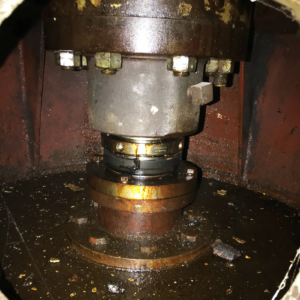
A bearing housing or mixer pedestal can also help isolate the mechanical seal from radial and axial loads. Understanding mechanical seals in pressurized mixers covers what the seal needs from the shaft.
Pressurized high viscosity mixing has to be considered as a complete system
The impeller, gearbox, shaft, bearings, seal, vessel, and process conditions all influence one another.
This is particularly important when viscosity changes during the batch.
A material may start relatively thin and become much more viscous as temperature changes, solids are added, solvent leaves the system, or a chemical reaction progresses.
The mixer should be evaluated for the most demanding realistic operating condition rather than just the easiest point in the batch. Selecting the right mixer for a pressurized tank sets out the process data that drives this.
Working with Agitation Resources
We build mixers for viscous duty, including large diameter and close clearance designs, and we machine shafts, hubs, and blades in house. Gearmotors come from SEW or Nord US plants, and we design and machine the adapter hardware ourselves.
Send us the rheology across the batch, not just the starting condition, and we will size the drive for the worst case. More on our pressurized tank mixers.