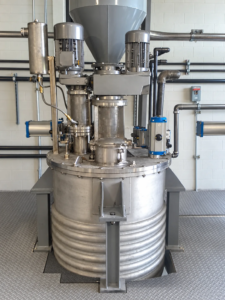
A pressurized mixer combines rotating equipment with a pressure vessel.
That makes the mechanical connection between the mixer and tank particularly important.
The mixer has to perform the process duty without creating loads, temperatures, electrical conditions, or sealing problems that exceed what the overall system was designed to handle.
How does the mixer affect a pressure vessel?
The mixer applies more than static weight to the vessel.
During operation, the impeller generates hydraulic forces that are transmitted through the shaft and mixer housing into the mounting nozzle.
Depending on the design, the vessel connection may see:
- Mixer weight
- Torque
- Axial thrust
- Radial loading
- Bending moment
- Startup loads
- Loads created during process upsets
These forces should be considered when the vessel nozzle and reinforcement are designed.
For an existing vessel, the available nozzle should be evaluated before installing a substantially different mixer.
A new mixer with a longer shaft, larger impeller, higher torque, or different mounting arrangement may impose loads that were not part of the original design.
What role does ASME Section VIII play?
In the United States, pressure vessel design is commonly governed by the ASME Boiler and Pressure Vessel Code, including Section VIII for many industrial vessels.
The pressure vessel designer or fabricator is responsible for determining how applied loads affect the vessel.
Mixer manufacturers can support that process by providing the mechanical loads developed by the mixer.
Depending on the vessel and application, additional analysis may be required around the nozzle connection and local vessel stresses.
The important point is coordination.
The vessel engineer needs accurate mixer loading information, and the mixer designer needs accurate vessel and nozzle information. Selecting the right mixer for a pressurized tank lists the vessel data that should be exchanged.
What about hazardous locations?
Some pressurized mixing applications also operate in electrically classified areas.
The required electrical equipment depends on the actual area classification, material being handled, and applicable electrical code.
This can affect:
- Motor selection
- VFD installation
- Junction boxes
- Switches
- Instrumentation
- Sensors
- Wiring methods
An explosion proof motor should not simply be added because a process sounds hazardous.
The electrical area classification should first be established by the responsible plant or electrical engineer. Equipment can then be selected to meet that classification.
Temperature code can also matter because equipment surface temperatures must remain appropriate for the material present in the classified environment.
How should the mixer interact with process safety systems?
For some processes, loss of agitation is more than a production problem.
Mixing may be necessary to maintain temperature uniformity, keep solids suspended, distribute reactants, or prevent localized concentration.
In those cases, mixer status can become part of the process control or safety strategy.
Possible monitored conditions include:
- Motor current
- Mixer speed
- Bearing temperature
- Vibration
- Seal system pressure
- Barrier fluid level
- Gearbox condition
Whether an alarm or automatic shutdown is required depends on the actual process hazard analysis and control philosophy.
For example, a drop in barrier pressure on a pressurized double seal system may indicate that the required pressure relationship across the seal is no longer being maintained. Understanding mechanical seals in pressurized mixers explains that relationship.
That may justify an alarm, shutdown, or another plant specific response.
Pressure protection remains a vessel function
The mixer does not replace the pressure protection required for the vessel.
Pressure relief valves, rupture disks, instrumentation, controls, and other safeguards should be designed as part of the overall process system.
The mixer should instead be evaluated as one piece of that system.
A good pressurized mixer design considers not only whether the impeller will move the fluid, but also how the mixer interacts with the vessel, mechanical seal, electrical classification, controls, and process safety requirements.
Working with Agitation Resources
We provide the mixer loads your vessel engineer needs for the nozzle and reinforcement check, and we design and machine mounting hardware, adapter plates, pedestals, and stools in house.
Send us the vessel drawing and the area classification along with the process data. More on our pressurized tank mixers.