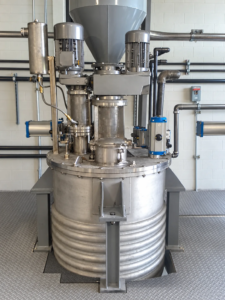
Any mixer shaft entering a closed vessel creates a potential leak path.
In an atmospheric tank, that may be addressed with relatively simple sealing arrangements depending on the process. Once the vessel is pressurized, under vacuum, or handling material that cannot be released to the surrounding environment, seal selection becomes considerably more important.
Mechanical seals are commonly used in these applications because they provide controlled sealing around a rotating shaft.
How does a mechanical seal work?
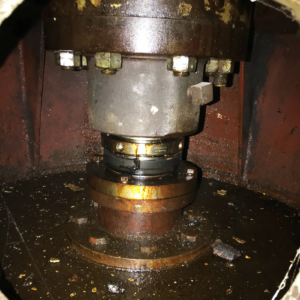
A mechanical seal normally uses two precision seal faces.
One face rotates with the shaft while the other remains stationary. The faces are held together while a very thin fluid film provides lubrication between them.
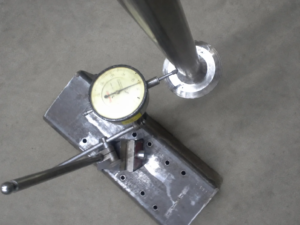
Because these surfaces operate against each other continuously, face condition, shaft runout, lubrication, temperature, and alignment all affect seal life.
This is also why the seal should not be treated as an accessory added after the mixer is designed. Shaft design, bearings, vessel pressure, process chemistry, and the seal arrangement all interact. Selecting the right mixer for a pressurized tank covers how those decisions fit together.
When can a single mechanical seal be used?
A single mechanical seal uses one set of sealing faces.
Depending on the process, this can be a practical solution for applications where the product is compatible with the seal materials and can provide suitable lubrication at the sealing interface.
The decision depends on more than pressure alone.
The process fluid should be evaluated for:
- Lubricating properties
- Abrasiveness
- Solids content
- Tendency to crystallize
- Tendency to polymerize
- Vapor pressure
- Chemical compatibility
- Hazard level
A fluid that looks straightforward from a pressure standpoint can still be very difficult to seal if it crystallizes, contains abrasive solids, or changes phase at the seal faces.
When should a double mechanical seal be considered?
Double seal arrangements are commonly considered when additional containment is needed or when the process fluid is not suitable for lubricating a single seal.
They are frequently used for hazardous, volatile, abrasive, or otherwise difficult services.
A double seal contains two sets of seal faces with a fluid between them.
In a pressurized barrier system, the barrier fluid is maintained above the process pressure. This creates a pressure gradient toward the vessel so that controlled leakage tends to move barrier fluid into the process rather than allowing process material to escape outward.
The exact pressure differential and support arrangement should be selected for the seal design and process requirements rather than treated as a universal value.
What materials are used for seal faces?
Common seal face materials include:
- Carbon graphite
- Silicon carbide
- Tungsten carbide
Material selection depends on the process chemistry, solids content, pressure, temperature, lubrication, and expected wear.
Carbon combinations are common in many general industrial applications because of their friction characteristics.
Silicon carbide is frequently considered where chemical resistance, hardness, and abrasion resistance are important.
Tungsten carbide can also be useful where mechanical toughness and wear resistance are required.
The correct combination should be selected around the process rather than simply choosing the hardest available material.
Why is seal temperature important?
Mechanical seal faces generate heat.
If that heat cannot be removed, the lubricating film between the faces can deteriorate. That can accelerate wear and eventually damage the seal.
Double seal systems may use an external reservoir or circulation system to control pressure, lubrication, and temperature.
Depending on the design, barrier or buffer fluid may circulate naturally or through a more actively controlled system.
The support system is therefore part of the sealing system itself. Routine checks on that system are covered in preventive maintenance for pressurized tank mixers.
What information should be reviewed before selecting a seal?
Useful information includes:
- Vessel pressure and vacuum conditions
- Temperature range
- Process fluid
- Solids concentration
- Chemical compatibility
- Shaft speed
- Shaft diameter
- Expected runout
- Area classification
- Acceptable leakage
- Cleaning requirements
- Maintenance requirements
Mechanical seals can be extremely reliable when they are matched to the application.
Problems usually start when the seal is selected independently of the mixer, process, or shaft design.
Working with Agitation Resources
We supply and fit seals on mixers from any manufacturer, including units we did not build, and we keep the drawings and part numbers on file for future work on the same unit.
Seal selection is handled alongside shaft and bearing design, so the arrangement suits the runout the mixer actually produces. More on our pressurized tank mixers.