The Fundamental Mechanics of an Industrial Mixer
The specification and implementation of an industrial mixer are among the most critical engineering decisions in chemical processing, wastewater treatment, and pharmaceutical manufacturing. At its core, an industrial mixer is designed to convert mechanical energy into fluid motion, creating controlled turbulence that ensures uniform blending, solid suspension, and optimal mass and heat transfer. The fundamental fluid dynamics governing these processes rely heavily on the dimensionless power number and the flow number, which dictate the relationship between the geometric properties of the impeller and its subsequent power draw in a fluid medium. When an impeller rotates, it generates a localized low-pressure zone that draws fluid into the blades, thereby accelerating it radially or axially, depending on the specific geometry of the mixing system.
Understanding the relationship between impeller diameter, rotational speed, and fluid viscosity is paramount to specifying the correct industrial mixer. The power drawn by a rotating impeller in a turbulent regime scales with the fluid density, the cube of the rotational speed, and the fifth power of the impeller diameter. Consequently, even a marginal increase in impeller diameter requires a massive increase in mechanical power, forcing engineers to carefully balance tank geometry against the available motor torque. Doubling the impeller diameter while holding all other variables constant increases the required power by a factor of 32, illustrating why precision engineering is absolutely non-negotiable when scaling up from a pilot plant to full-scale production. In typical scale-up scenarios for liquid blending, engineers maintain a constant power per unit volume to ensure the mixing intensity remains consistent regardless of vessel size.
Without properly engineered equipment, facilities frequently experience severe mixing inefficiencies, such as dead zones, excessive fluid swirling, or heavy solids accumulating on the tank floor. To counteract the natural tendency of fluid to enter solid-body rotation—a state where the liquid simply spins with the shaft without actually mixing—engineers introduce baffles into the vessel architecture. Baffles disrupt this circular flow, converting rotational kinetic energy into the axial and radial flow patterns required to achieve a homogeneous batch. The precise engineering of these mechanical components dictates whether an industrial mixer will perform reliably over a decades-long lifespan or succumb to premature mechanical failure.
Agitation Resources: Precision Manufacturing Across the United States
Operating out of a state-of-the-art facility in Walhalla, South Carolina, Agitation Resources is a premier designer and manufacturer of heavy-duty agitation equipment, proudly serving industries across the United States. As a dedicated division of Keystone Industries, LLC, the company eliminates the operational risks associated with cookie-cutter machinery by custom-tailoring every industrial mixer to the exact fluid dynamics and mechanical constraints of the client’s specific process. The core philosophy driving Agitation Resources is that batch consistency remains the ultimate metric of industrial success. A poorly specified industrial mixer can lead to uneven chemical reactions, ruined product batches, stalled production lines, and devastating financial losses.
To prevent these costly operational setbacks, Agitation Resources merges rigorous chemical and mechanical engineering with precision in-house fabrication. By managing both the complex engineering design and the physical manufacturing under one roof, the company maintains absolute control over quality assurance and consistently delivers some of the fastest lead times in the marketplace. Their comprehensive engineering support extends from the initial fluid sizing and torque calculations to three-dimensional modeling, final assembly, and long-term maintenance. Whether a facility requires a massive agitation system for chemical processing, an intricate sanitary mixer for food and beverage production, or specialized equipment for high-viscosity paints and coatings, Agitation Resources provides the dedicated technical expertise to solve the most daunting fluid-processing challenges anywhere in the country.
Exploring the Spectrum of Industrial Mixer Configurations
Because no two fluid processes are identical, an industrial mixer must be structurally configured to match the specific geometry, volume, and operational pressures of the containment vessel. Agitation Resources manufactures a comprehensive portfolio of mixing systems designed to accommodate everything from small-scale laboratory blending to massive petrochemical storage, ensuring that the precise flow pattern is achieved for every unique application.
Top-Entry Mixers for Symmetrical Flow Patterns
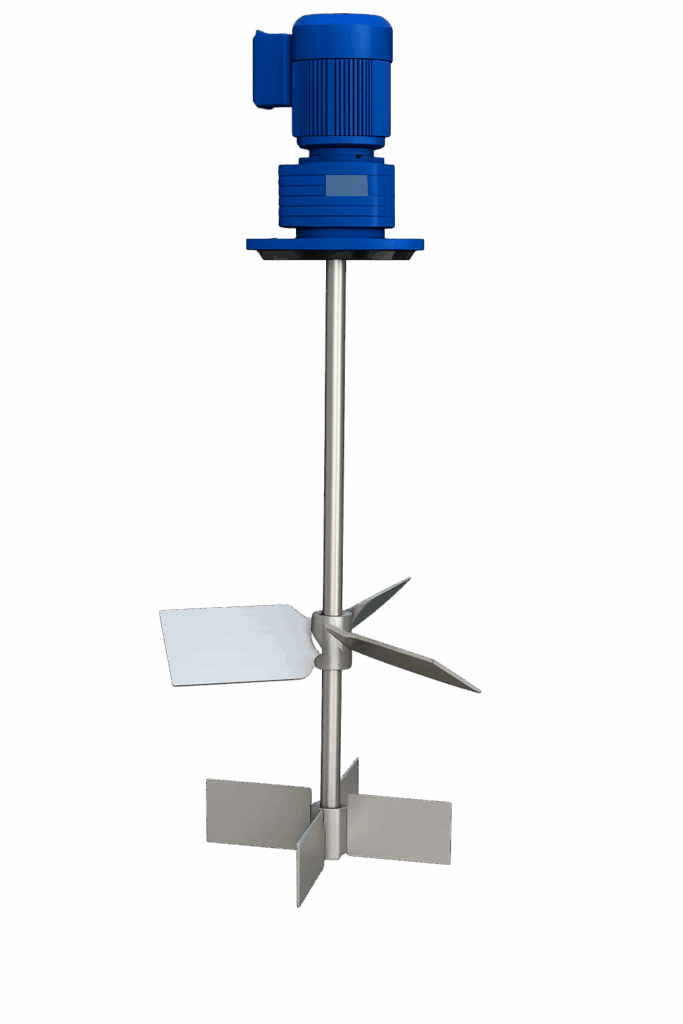
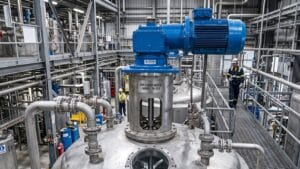
The AHM Group represents the flagship line of heavy-duty top-entry mixers engineered for industrial tanks and large-scale open vessels. Top-entry mixers are universally recognized as the most efficient configuration for achieving symmetrical flow patterns that promote comprehensive top-to-bottom fluid turnover. Mounted directly on the roof or upper structural supports of a process vessel, these units place the impeller centrally within the fluid column, ensuring that mechanical energy is distributed evenly throughout the batch. The AHM Group mixers are available in both direct-drive and gear-reduced configurations, providing exceptional long-term reliability and precise torque delivery for demanding industrial environments. Engineers typically specify these units for applications requiring heavy solid suspension, rapid chemical flash mixing, and reliable continuous blending across diverse industrial sectors.
Pressurized Tank Mixers for Non-Atmospheric Environments
When chemical reactions generate fugitive emissions, or when a process must be executed under strict vacuum conditions, standard open-air agitation is entirely inadequate. The ASM Group of pressurized tank mixers is specifically engineered for sealed, non-atmospheric environments where absolute containment is legally and operationally mandated. Sharing the robust mechanical core of the AHM Group, the ASM models incorporate sophisticated sealing technologies to ensure total process isolation. Agitation Resources outfits these units with a variety of process-specific seals, including lip seals for low-pressure applications, split mechanical seals or packed stuffing boxes for moderate pressure environments, and highly advanced single or double cartridge mechanical seals for absolute containment in high-pressure or full-vacuum reactors.
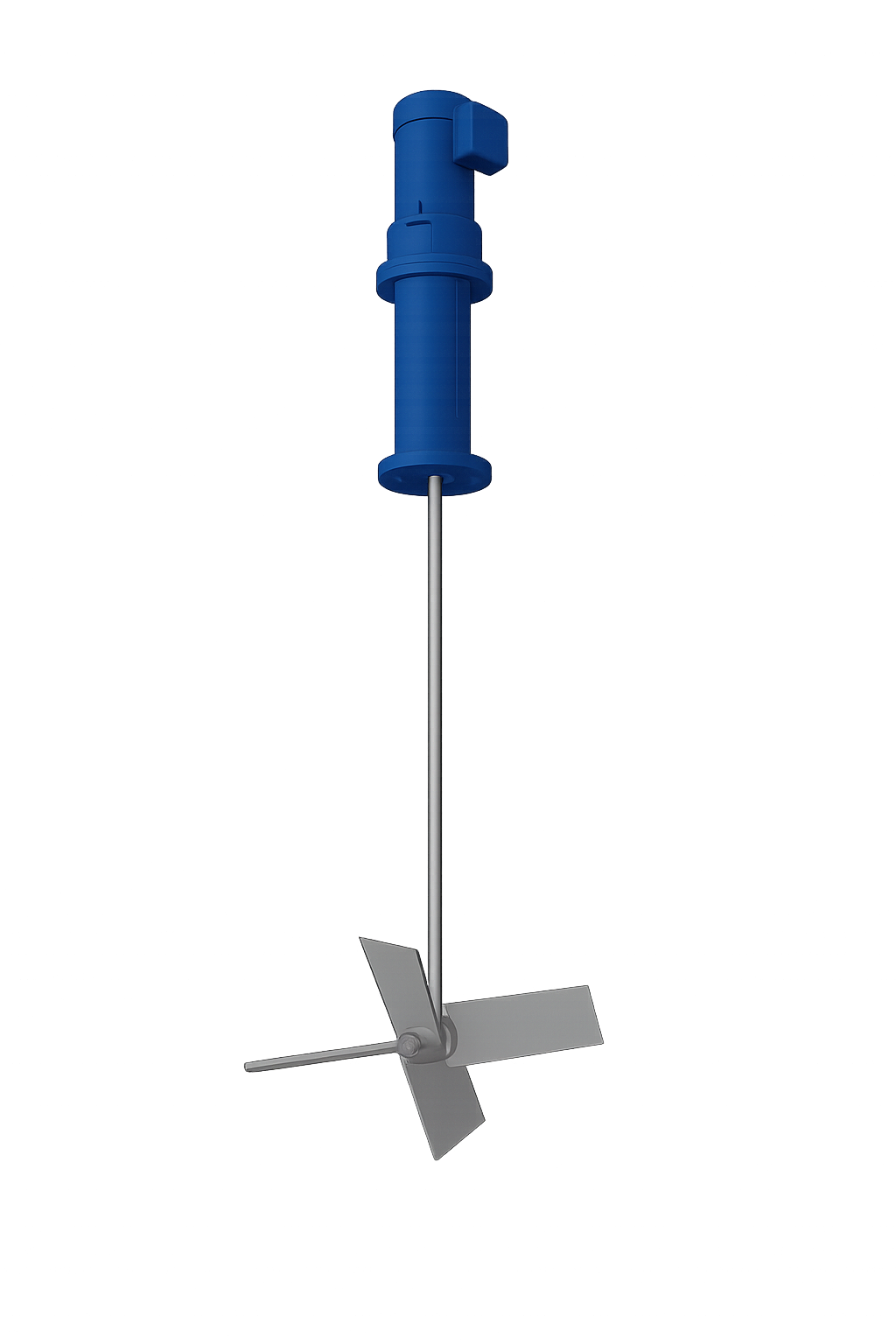
| Specification Parameter | Technical Details for ASM Group Pressurized Mixers |
| Motor Power Capacity | Engineered to support up to 200 horsepower |
| Motor Standards | Fully compatible with stringent NEMA and IEC standards |
| Mounting Orientation | Pedestal or flange-mounted designs for structural integrity |
| Drive Mechanism | Available in direct-drive or high-efficiency gear-reduced options |
| Shaft Diameter Range | Heavy-duty designs ranging from 1.0 inch to 4.5 inches |
| Power Transmission | Premium gear reducers achieving 95 to 98 percent efficiency |
| Mechanical Durability | Bearings rated for an extended L-10 lifespan of 100,000 hours |
| Process Containment | Single or double cartridge mechanical seals and stuffing boxes |
This level of stringent engineering is critical for solvent mixing systems, vacuum reactors, and specialty chemical blending, where the escape of hazardous vapors could pose catastrophic safety and environmental risks.
Side-Entry Mixers for High-Capacity Vessels
In massive storage tanks typically found in the petrochemical, refinery, and pulp and paper industries, installing a top-entry mixer is often structurally impractical or prohibitively expensive due to the enormous shaft lengths required to reach the fluid bed. To address these extreme geometric constraints, Agitation Resources developed the ASN Group of side-entry mixers. Mounted horizontally on the lower flange of a tank, these units are purpose-built to deliver consistent, high-torque performance across massive fluid volumes. The ASN Group utilizes premium gear reducers boasting transmission efficiencies up to 98%, driving heavy-duty precision shafts that withstand the severe radial loads associated with horizontal agitation.
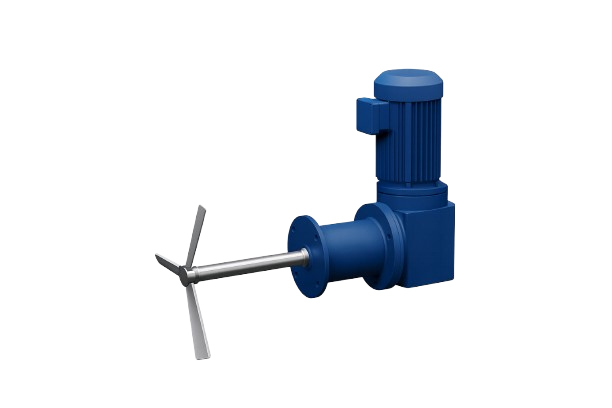
| Specification Parameter | Technical Details for ASN Group Side-Entry Mixers |
| Application Scale | Designed for large-scale blending and petrochemical storage |
| Motor Power Output | Scalable up to 200 horsepower for immense tank volumes |
| System Mounting | Engineered for robust horizontal side-entry flange integration |
| Impeller Configurations | Pitched-blade turbines or custom designs for horizontal flow |
| Shaft Dimensions | High-strength shafts ranging from 1.0 inch to 4.5 inches |
| Transmission Efficiency | High-efficiency mechanical drives yielding up to 98 percent transfer |
| Bearing Longevity | Precision bearings delivering 100,000 hours of continuous operation |
| Fluid Containment | Packed stuffing boxes or mechanical seals for hydrostatic pressure |
Because side-entry shafts penetrate the vessel entirely below the liquid line, these mixers rely on precisely engineered packed stuffing boxes or heavy-duty mechanical seals to prevent catastrophic fluid leaks under the massive hydrostatic pressure of the storage tank.
Portable Mixers for Flexible Operational Demands
For production facilities that require rapid deployment and unmatched operational flexibility, the ARIP Group offers a rugged yet lightweight line of portable mixers. These versatile units are meticulously designed for temporary mixing applications, pilot plant studies, and research and development environments where equipment must be frequently relocated between different smaller tanks and vessels. Available in highly adaptable clamp-on or cup-mounted configurations, the ARIP series enables operators to achieve exceptional blending performance without permanently mounting a structural mount to a single vessel.
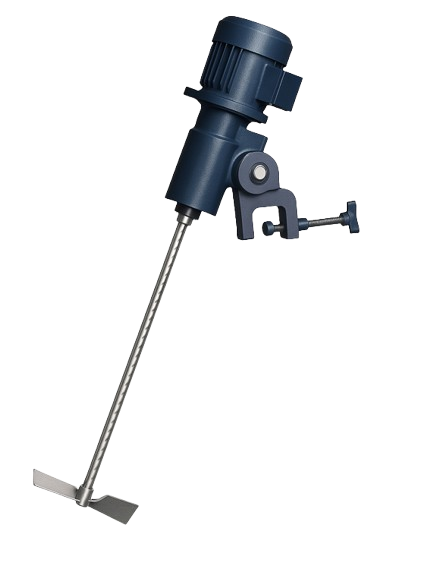
| Specification Parameter | Technical Details for ARIP Group Portable Mixers |
| Motor Power Output | Fractional horsepower scaling up to a maximum of 3 horsepower |
| Motor Compliance | Built to satisfy strict NEMA and IEC electrical standards |
| Mounting Configurations | Highly flexible clamp-on or rigid cup-mounted assemblies |
| Drive Architecture | Configurable as direct-drive or gear-reduced mechanical systems |
| Shaft Dimensions | Precision machined shafts ranging from 0.75 inches to 1.25 inches |
| Bearing Specifications | Sealed and grease-lubricated bearings with a 100,000-hour rating |
| Housing Materials | Rugged SAE Class 30 cast iron or lightweight industrial aluminum |
| Impeller Options | Pitched-blade turbines and highly efficient process hydrofoils |
Despite their incredibly compact footprint, ARIP portable mixers maintain the exact same precision standards as their larger counterparts, ensuring vibration-free performance and superior operator safety during solvent preparation, wastewater neutralization, and delicate food ingredient blending.
Small Batch Mixers for Specialized Formulations
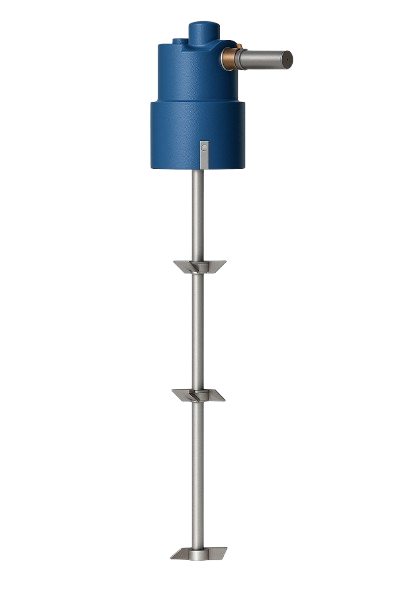
Filling the crucial gap between laboratory-scale stirrers and massive industrial agitators, the ATM Group comprises highly reliable small-batch mixers designed specifically for totes and drums. Formulating specialty chemicals, high-value pharmaceuticals, or low-volume cosmetics requires an industrial mixer capable of delivering intense mechanical shear and rapid blending without the massive spatial footprint of a traditional chemical reactor. The ATM Group meets these strict parameters by providing multiple mounting options and high-performance impellers tailored exclusively to mobile, small-batch applications. These units guarantee that the stringent quality control metrics required for limited production runs are met with absolute consistency, safeguarding the molecular integrity of the high-value product.
Advanced Components: Impellers, Shaft Dynamics, and Baffles
The operational success of an industrial mixer is heavily dependent on the mechanical synergy between its internal components. The impeller serves as the primary physical interface between the machine and the fluid, and its geometric profile dictates the shear rate and flow pattern generated within the tank. Agitation Resources precision-engineers an extensive array of impellers, including pitched-blade turbines for optimal axial flow, hydrofoils for energy-efficient liquid blending, and specialized anchor, gate, and helical ribbon configurations designed exclusively for ultra-high-viscosity materials that standard turbines simply cannot process.
The mechanical integrity of the agitator shaft is equally vital, particularly concerning the hazardous phenomenon known as critical speed. Every rotating shaft acts as an elastic structure with a natural resonant frequency, which dictates its mechanical stability. If an industrial mixer is operated at a rotational velocity that approaches this critical speed, the shaft will experience severe lateral deflection, bowing outward violently due to the centrifugal forces acting upon natural microscopic unbalances within the system. This whirling effect rapidly amplifies, creating massive radial displacements that can destroy mechanical seals, shatter gearboxes, and ultimately cause the shaft to yield or fracture catastrophically. To prevent such mechanical failures, heavy-duty industrial mixers are meticulously engineered to operate well outside this danger zone, typically constrained to run at roughly sixty-five to seventy percent of the shaft’s first critical speed.
In sanitary mixing applications, the surface finish of these wetted components becomes the primary engineering focus. While standard industrial applications readily tolerate basic mechanical polishing, industries strictly regulated by federal health agencies must meet rigorous hygiene standards to prevent bacterial adhesion and biofilm formation. A standard 3-A sanitary certification, typically used in the dairy and food processing sectors, generally requires a mechanical polish, resulting in a surface roughness average of 32 microinches. However, high-purity pharmaceutical manufacturing demands compliance with the far more stringent ASME Bioprocessing Equipment standards. To meet ASME specifications, an industrial mixer must feature tightly controlled fluid geometries to eliminate dead legs and undergo advanced electropolishing to achieve surface finishes as smooth as 15 microinches. Electropolishing is a sophisticated electrochemical process that dissolves microscopic surface peaks and completely removes embedded free iron, leaving behind a pristine, chromium-enriched passive layer that exhibits exceptional corrosion resistance in highly sterile manufacturing environments.
| Engineering Parameter | 3-A Sanitary Design Standards | ASME Bioprocessing Equipment Standards |
| Primary Industries | Food, beverage, dairy, and commercial cosmetics | Pharmaceuticals, biotech, and high-purity chemical processing |
| Standard Material | Commonly accepts 304 and 316 stainless steel | Strictly requires high-grade 316L stainless steel for purity |
| Surface Finish | Typically utilizes a mechanical polish rated at 32 Ra | Requires electropolished finishes down to 15 Ra |
| System Geometry | Tolerates minor pooling if the system remains cleanable | Mandates strict self-draining designs with zero dead legs |
| Material Traceability | Material Test Reports are occasionally considered optional | Requires absolute traceability and heat numbers on all parts |
| Process Bioburden | Engineered for environments with moderate bioburden risk | Absolutely essential for high-risk injectables and cellular cultures |
Predictive Modeling and Computational Fluid Dynamics in Mixer Design
The historical era of trial-and-error physical testing in agitation design has been entirely superseded by the integration of Computational Fluid Dynamics. This advanced mathematical modeling utilizes high-performance computing to simulate the exact physical behavior of fluid flow within a digital replica of the agitated vessel. By solving complex Navier-Stokes equations and turbulent kinetic energy models, engineers can virtually visualize the velocity distributions, shear rates, and pressure gradients generated by a specific industrial mixer design long before any steel is actually cut in the fabrication facility.
Computational Fluid Dynamics empowers the engineering team at Agitation Resources to identify and completely eliminate problematic flow patterns, such as stagnation zones where heavier solids might settle, or areas of excessive fluid shear that could permanently damage shear-sensitive polymers or fragile biological cell cultures. Furthermore, these rigorous digital simulations provide highly accurate predictions of the total mechanical power draw, enabling precise specification of motor sizes and gear reducer ratios. By leveraging this sophisticated predictive software alongside empirical scaling correlations, Agitation Resources guarantees that the final physical equipment will perform exactly as theorized, vastly reducing commissioning time and ensuring immediate process optimization upon installation at the client’s facility.
Ensuring Longevity: Service Factors and Equipment Retrofits
To guarantee that an industrial mixer can survive the grueling demands of continuous factory operation, engineers must apply stringent mechanical service factors to the drive systems. Calculated using guidelines established by the American Gear Manufacturers Association, a service factor is a vital mathematical safety margin that dictates how much operational overload a gear reducer can safely tolerate before sustaining irreversible internal damage. A gearbox rated with a service factor of 1.0 is designed merely to handle the exact nominal horsepower of the application under perfect, steady-state conditions. However, real-world industrial environments are inherently unpredictable.
Applications involving heavy shock loads, frequent motor starts and stops, non-uniform fluid densities, or continuous twenty-four-hour operation impose immense mechanical stress on the gear teeth and internal bearings. By specifying an industrial mixer with an elevated service factor of 1.5 or 2.0, engineers intentionally over-design the mechanical capacity of the entire drive unit. This critical protective margin safely absorbs operational shocks and torque spikes, drastically extending the L-10 lifespan of the internal bearings from a few thousand hours to well over 100,000 hours of continuous service. Ignoring these vital service factors inevitably leads to stripped internal gears, catastrophic bearing failure, and agonizingly expensive facility downtime.
Beyond manufacturing brand-new equipment, Agitation Resources provides comprehensive lifecycle support to keep existing process lines operating at peak mechanical efficiency. The company executes highly complex equipment retrofits, strategically upgrading older, underperforming mixers with modern, high-efficiency impeller geometries and advanced mechanical seals to prevent hazardous leaks. When a massive industrial mixer eventually suffers severe mechanical wear after years of grueling service, Agitation Resources offers expert teardown, forensic inspection, shaft machining, and complete system rebuilds, fully restoring the equipment to original manufacturer specifications or better. Their unique ability to supply engineered aftermarket parts and provide on-site technical guidance during reinstallation ensures that clients receive comprehensive, uninterrupted engineering support long after the point of sale.