
Industrial mixing impellers sit at the heart of every industrial agitation system. This rotating component decides how efficiently your materials blend, how much energy you burn, and whether your final product actually meets quality standards.
Five main types of impellers dominate industrial mixing applications: hydrofoils, propellers, turbines, dispersion blades, and rotor-stators. Each one is built to create specific flow patterns and shear levels for different mixing processes.
Understanding how different impeller designs affect mixing performance helps you pick the right equipment for your operation. The shape, size, and blade configuration of your impeller directly impact flow dynamics, particle distribution, and energy efficiency.
Need gentle blending for thin liquids? Or maybe you’re after intense shear for emulsification? Matching the impeller type to your process goals can prevent equipment damage and those annoying product quality issues.
Your choice of agitator impeller affects operating costs, batch consistency, and production speed. The wrong impeller wastes energy, creates hot spots, or just fails to mix things properly.
Key Takeaways
- Different impeller types create specific flow patterns and shear levels suited for particular mixing applications
- Selecting the right impeller depends on your product viscosity, required shear intensity, and tank geometry
- Modern impeller designs balance energy efficiency with mixing performance to reduce operational costs
Industrial Mixing Impellers: Fundamental Classification
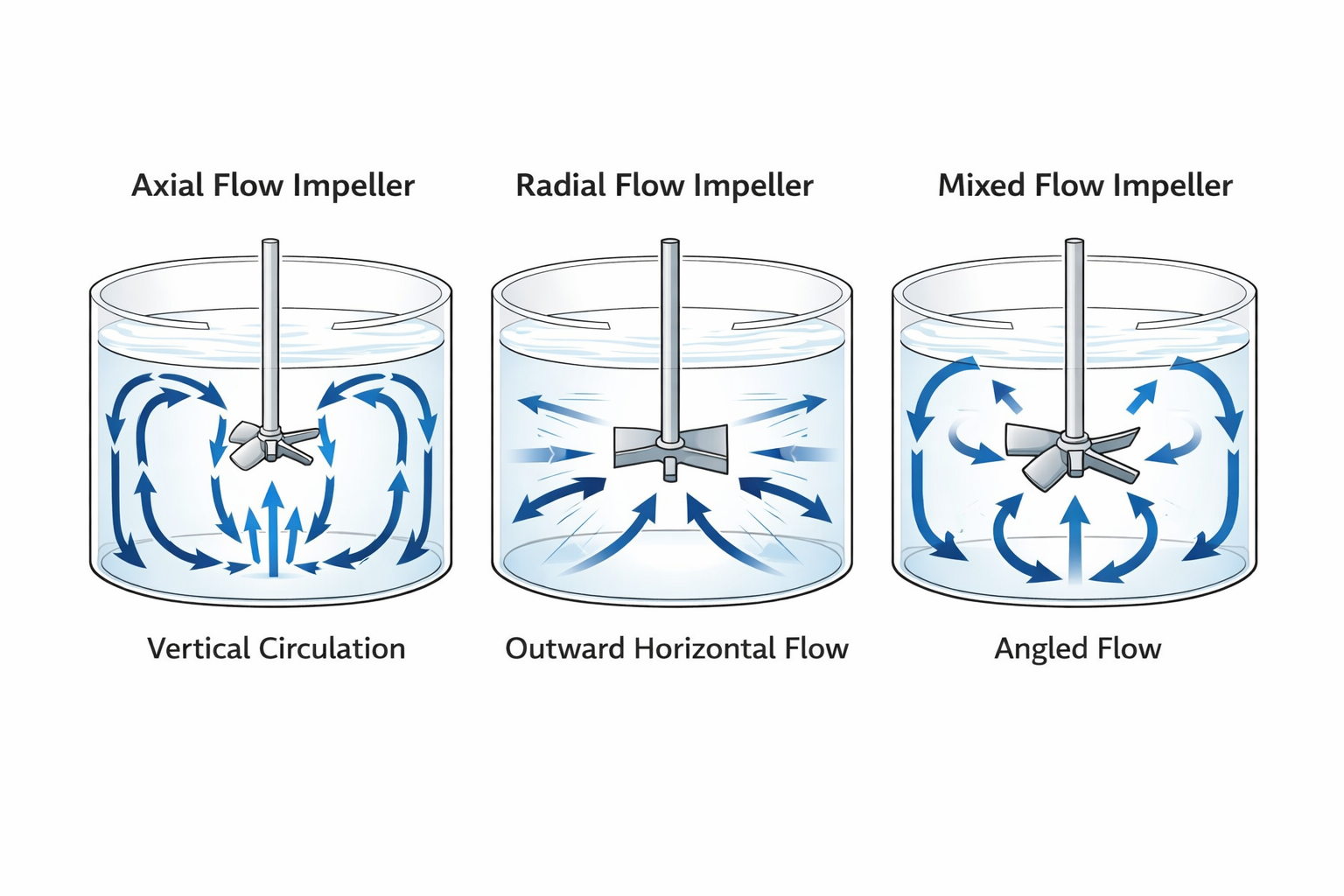
Impellers generate distinct flow patterns that determine how fluid moves through your mixing vessel. The three primary types are axial flow, radial flow, and mixed flow, and each suits different mixing objectives.
Axial Flow Impellers vs. Radial Flow Impellers
Axial flow impellers move fluid parallel to the mixer shaft, pushing liquid top-to-bottom throughout your tank. This design prevents stratification in low-viscosity liquids and keeps solids suspended.
Hydrofoil impellers and propellers are the most common axial flow designs you’ll see. Radial flow impellers, on the other hand, push fluid outward from the shaft at a 90-degree angle toward your tank walls.
The fluid then moves up and down the vessel walls, creating a totally different circulation pattern. These impeller types work well when you need higher shear forces at the impeller blade.
Key differences include:
- Flow direction: Axial creates vertical movement; radial generates horizontal movement
- Shear levels: Axial impellers produce lower shear; radial impellers generate higher shear
- Power consumption: Axial designs typically use less energy for bulk blending
- Best applications: Axial for general agitation and solid suspension; radial for dispersion tasks
Mixed Flow and Other Specialized Impellers
Mixed flow impellers combine features of both axial and radial designs. They create fluid movement at an angle—usually between 30 and 60 degrees from the shaft.
Pitched blade turbines are the most common mixed flow option. These designs give you a balance between circulation and shear.
You get better overall mixing than purely radial designs, but still keep more shear than standard axial impellers. Specialized impellers like vortex impellers handle viscous fluids or materials with fibers that would clog conventional designs.
Your impeller selection depends on your specific process requirements. Mixed flow options work well when you need moderate levels of both circulation and dispersion in a single impeller.
Influence of Flow Patterns on Mixing Efficiency
The flow pattern your mixing impeller creates directly affects how quickly you achieve a uniform mixture. Axial flow patterns provide excellent bulk movement, so you’ll see reduced mixing time for basic blending jobs.
This efficiency comes from moving large volumes of fluid with every rotation. Radial flow patterns concentrate energy near the impeller, which makes them ideal for breaking down particles or creating emulsions.
But you may need baffles or even multiple impellers to get full tank turnover. Poor flow patterns leave dead zones where material sits and becomes stagnant.
Your tank geometry also changes which flow pattern works best. Tall, narrow tanks benefit from axial flow to prevent stratification from top to bottom, while wide, shallow vessels often perform better with radial or mixed flow designs that reach the outer edges more effectively.
Detailed Overview of Key Impeller Designs
Different impeller designs serve specific purposes based on their blade geometry and flow characteristics. The shape and angle of impeller blades decide whether you get gentle circulation or intense shear forces in your mixing process.
Hydrofoil and High-Efficiency Impellers
Hydrofoil impellers generate strong axial flow while using less energy than traditional designs. These high-efficiency impellers (HEI) move large volumes of fluid with minimal shear, making them ideal for blending low-viscosity liquids.
The streamlined blade shape reduces drag and power consumption. Hydrofoil impellers often exhibit lower power numbers than radial turbines, allowing high circulation rates with relatively low energy input in many mixing applications.
Key Features:
- Flow Pattern: Primarily axial
- Shear Level: Low
- Best Applications: Bulk blending, gentle mixing, large tank circulation
- Viscosity Range: Low to medium
Your hydrofoil impeller works by creating a lifting force, similar to an airplane wing. There are typically three or four blades which consist of a twisted airfoil profile.
This design lets you achieve excellent top-to-bottom turnover in your tank while keeping power requirements low.
Propellers and Marine-Type Impellers
Marine-type propellers create axial flow patterns that work well for rapid mixing in smaller vessels. These impellers typically run at higher speeds than hydrofoils and typically have three angled blades that push fluid parallel to the shaft.
Propellers come in handy when you need fast circulation in low-viscosity fluids. The blade pitch angle usually falls between 15 and 45 degrees, affecting both flow rate and power draw.
Comparison to Hydrofoils:
| Feature | Propellers | Hydrofoils |
| Speed | Higher RPM | Lower RPM |
| Diameter | Smaller | Larger |
| Efficiency | Moderate | High |
| Shear at Tips | Higher | Lower |
You should select marine-type propellers for smaller tank volumes or when faster batch turnover is required. Typically, they’re great for solids suspension and basic liquid blending, though they might generate more localized shear than hydrofoils.
Turbine and Pitched Blade Impellers
The pitched blade turbine gives you versatility with adjustable blade angles that control flow and shear. These turbine impellers use flat or angled blades mounted on a central hub, so you get both radial and axial flow components.
A pitched blade impeller typically features three to six blades set at 30 or 45 degrees. This angle provides a good balance between pumping capacity and shear generation.
Radial turbines push fluid outward perpendicular to the shaft. They create higher turbulence than axial designs, which makes them suitable for gas dispersion and heat transfer applications.
The flat blade design generates moderate to high shear with strong radial flow patterns.
Applications by Type:
- Pitched Blade: Medium-viscosity blending, heat transfer, suspension
- Radial Turbine: Gas dispersion, emulsification, reactions requiring turbulence
The power number and pumping number help you compare turbine efficiency during the design phase. Power number (Np) shows energy consumption, while pumping number (Nq) measures flow generation.
Your selection should balance these values based on your process requirements.
Is it always obvious which one to choose? Not always!
Dispersion and Shear-Focused Blades
Dispersion blades deliver intense localized shear for breaking down particles and creating fine emulsions. These high-shear impellers rely on high tip speeds rather than bulk fluid movement to get results.
A typical dispersion blade features lots of teeth around its edge. Those teeth create extreme turbulence as they spin at high speeds, sometimes 3,000 to 5,000 feet per minute at the tips.
You’ll want shear impellers when you need to incorporate powders into liquids or reduce particle size. They excel at wetting dry ingredients and creating stable suspensions through mechanical energy.
Common Shear Blade Types:
- Cowles Blade: Toothed disc design for paint and coatings
- Dispersion Disc: Flat blade with peripheral teeth
- Sawtooth Design: Aggressive particle size reduction
Tickler blades work alongside high-shear impellers to improve overall mixing. These small auxiliary blades keep material from settling at the tank bottom during low level mixing operations.
Your dispersion system may need several impeller types working together to achieve complete homogenization throughout the vessel. Mixing isn’t always a one-tool job, right?
Performance Considerations and Impeller Selection Criteria
Selecting the right impeller means matching your fluid properties and process goals to the mechanical design of your mixing system. Viscosity decides how much energy you need to move materials, while the relationship between flow and shear determines how ingredients blend.
Viscosity and Fluid Properties
Viscosity directly affects how your impeller transfers energy into the fluid. Low-viscosity fluids like water flow easily, so you want impellers that create high pumping rates with minimal power.
High-viscosity materials resist movement, so you’ll need larger impeller diameters operating at slower speeds to generate enough circulation. The relationship between shear rate and shear stress determines how your fluid responds to mixing.
Newtonian fluids keep constant viscosity regardless of shear rate. Non-Newtonian fluids change viscosity under stress, so you need to pick impellers that account for these quirks.
Key viscosity ranges and requirements:
- Low viscosity (1-100 cP): High-flow impellers like hydrofoils and propellers
- Medium viscosity (100-5,000 cP): Pitched blade turbines or helical ribbons
- High viscosity (5,000+ cP): Anchor or gate impellers with large diameters
Your fluid properties also determine whether you need gentle agitation for shear-sensitive applications or aggressive mixing for particle breakdown. Sometimes, it’s a bit of trial and error to get it just right.
Flow, Shear, and Pumping Characteristics
Flow and shear work against each other in mixing systems. If you ramp up flow, you’ll see shear drop and the opposite is true as well.
Getting this balance right is key when you’re picking impellers for your process. It’s not always obvious, is it?
Pumping rate tells you how much fluid your impeller moves each time it spins. Generally, high-flow impellers like hydrofoils really stir things up, creating strong currents that keep solids from settling.
Tank turnover describes how fast your entire batch cycles through the impeller zone. It’s a good way to measure mixing efficiency.
Shear rate spikes near the tips of the impeller blades, where velocity peaks. If you need to break down particles or whip up emulsions, high-shear impellers focus energy into tight zones.
Low-shear designs, on the other hand, spread energy out over a bigger area for gentle blending. Sometimes you need to go easy on your ingredients.
Flow and shear characteristics by impeller style:
| Impeller Type | Flow Pattern | Shear Level | Primary Use |
| Hydrofoil | Axial | Low | Bulk blending |
| Propeller | Axial | Low-Medium | Liquid mixing |
| Pitched Blade | Mixed | Medium | General purpose |
| Dispersion Blade | Radial | High | Particle reduction |
| Rotor-Stator | Minimal | Ultra-High | Emulsification |
Mixing Vessel Design and Impeller Geometry
Your mixing vessel’s shape and size affect how well your impeller circulates fluid. Most of the time, impeller diameter falls somewhere between 25% and 50% of your tank diameter.
If you go bigger, you boost pumping power, but you’ll also need more energy and torque. It’s always a tradeoff, isn’t it?
Bottom clearance makes a difference for solids suspension and overall flow. Setting your impeller about one diameter above the tank bottom usually keeps solids off the floor.
Don’t forget about liquid submergence.
Keep the impeller at least one diameter below the surface to avoid vortexing and air getting sucked in.
If you want to keep particles suspended, you have to maintain enough velocity across the tank bottom. Otherwise, you’re just asking for dead zones where solids pile up.
Critical geometric ratios:
- Impeller-to-tank diameter: 0.3 to 0.5
- Off-bottom clearance: 0.25 to 0.5 impeller diameters
- Liquid height-to-tank diameter: 0.75 to 1.5
Baffles in the tank stop swirling and help circulation from top to bottom, especially when things get turbulent. If you size your impeller and speed carefully, you’ll save on energy costs over time.
Typical Mixer Applications by Impeller Type
Mixers aren’t one-size-fits-all. Hydrofoils really shine with low-viscosity liquids and large tanks, especially if you care about energy efficiency.
They move material quickly and don’t generate much heat. That’s a big plus for temperature-sensitive batches.
Propellers come in handy for fast liquid blending in small tanks. You can turn batches over quickly, so they’re great when speed matters.
Pitched blade turbines handle medium-viscosity fluids and strike a balance between shear and flow. They’re versatile and can disperse solids while keeping things moving.
Dispersion blades focus shear energy to break up clumps and mix powders into liquids. You lose some overall flow, but you gain serious particle size reduction.
Rotor-stators? They’re in a league of their own when it comes to emulsions and super-fine dispersions. The tight gap between rotor and stator creates intense shear, sometimes breaking particles down below 10 microns.
Usually, you’ll see rotor-stators paired with other impellers. On their own, they don’t move much fluid.
Emerging Trends and Niche Impeller Technologies
Some impeller designs tackle tough mixing jobs in demanding industries. New materials are also stepping up to meet stricter sanitary and corrosion standards.
Folding, Anchor, and Specialty Impellers
Folding impellers are clever. They fold up to fit through tight tank openings, then pop open inside to full size. It’s a creative solution if you need to upgrade an old tank but can’t cut a bigger hole.
Anchor impellers have big blades that sweep close to the tank wall. They keep sticky, high-viscosity products from building up on the sides and scrape surfaces as they turn.
The slow speed creates a gentle mixing action, but it still gets the job done. Sometimes slow and steady really does win the race.
Specialty impellers for industrial applications include gas dispersion types that break up bubbles in liquid. These use unique blade shapes to create aggressive flow, which is essential for certain chemical reactions where gas and liquid need to mix thoroughly.
Industries like mining and wastewater treatment often rely on these specialty designs. Standard impellers just can’t deliver the level of dispersion required in those environments.
Material Innovations and Sanitary Requirements
Modern sanitary and industrial mixing impellers rely on advanced materials to meet strict hygiene standards. Stainless steel still leads the pack for food, pharmaceutical, and biotech uses because it shrugs off corrosion and cleans up with less hassle.
Surface finish definitely matters in sanitary mixing. Polished stainless steel impellers with smooth, almost mirror-like surfaces help keep bacteria and gunk from sticking around.
You’ll need these finishes if you’re mixing products for people or anything medical. No one wants to risk contamination, right?
Special coatings step in when things get corrosive. PTFE coatings can handle harsh chemicals and still keep surfaces slick and easy to clean.
Some companies are utilizing exotic alloys like Hastelloy for the really tough chemical jobs. Your choice of material? It all comes down to your product’s chemistry, temperature needs, and how you plan to clean everything.
For high-purity work, you might need impellers with electropolished surfaces that meet ultra-specific roughness specs. It’s a lot to consider, but it’s worth it for peace of mind.